
Introduction
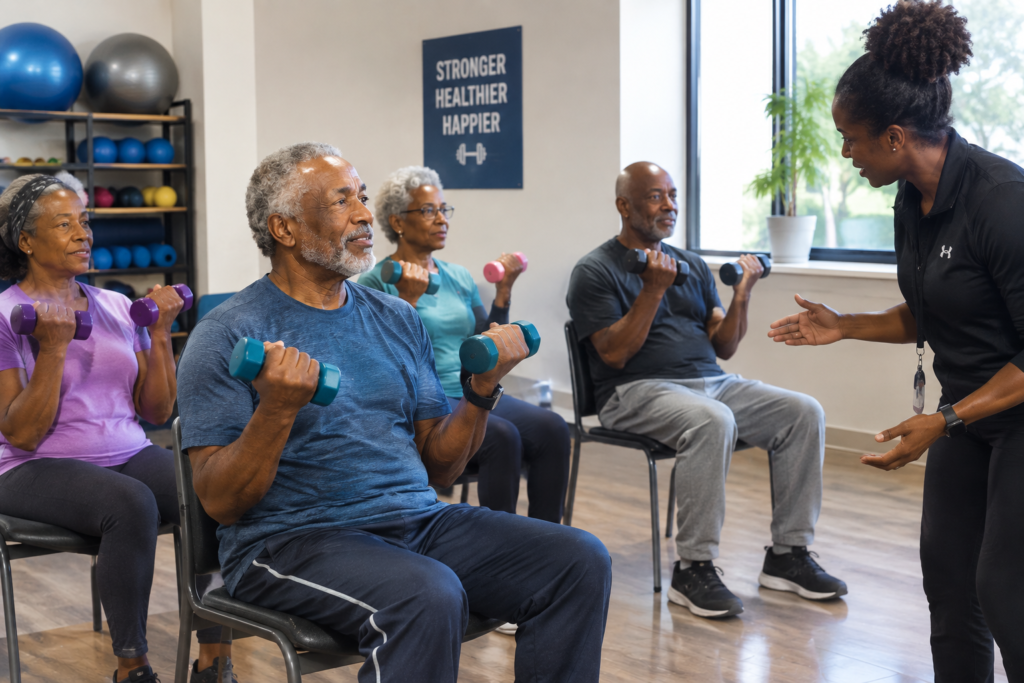
As we get older, we realise that we are no longer capable of doing certain activities as easily as we used to, like flying up a flight of stairs or lifting weights without hurting our backs or panting for dear life.
But what if I told you that you could get stronger, maintain your agility, and stay vibrant as you age, simply by incorporating strength training into your routine?
Well, in this article, I’ll be sharing some of the juicy tips used by seasoned strength trainers to help you get back that sweet 16 vibe, even at age 60!
So make sure you read till the end of this article so you don’t miss any important details, especially the simple tips that can help you get started with strength training safely and effectively.
What Happens to Your Body as You Age?
The older we become, our cells, tissues, and organs begin to experience natural changes that affect different systems in our bodies.
Wrinkles and skin discolouration are visible signs of ageing in adults. However, behind the scenes, several other processes take place that contribute to the ageing process. Some of the major changes we need to address include:
Bone Density Drops
Our bones are made of minerals that keep them dense and strong. However, as we grow older, our bodies may begin to break down bone faster than new bone can be formed.
As a result, our bones gradually lose their internal mass, become more porous, and become more likely to fracture or break from minor impacts.
Muscle Mass Shrinks
Our muscles serve as our body’s armour and engine. They help us move, maintain our strength, protect our joints and bones, regulate blood sugar, and help our bodies burn calories even when we are not exercising.
However, research shows that adults naturally lose 3% to 8% of their muscle mass at the age of 30, with the rate accelerating sharply after age 60 Clevelandclinic With the gradual decline in muscle mass, it becomes increasingly difficult to perform daily activities as we get older, and everyday movements can become harder.
Joints Stiffen
Your knees, hips, and fingers may become less flexible due to several anatomical changes that go on in your body as you grow older. This could make bending and movement more difficult and sometimes even painful.
Metabolism and Digestion
Metabolism refers to the chemical processes your body undergoes to convert food and drinks into energy. Research suggests that metabolism remains relatively stable between early adulthood and around age 60, after which energy expenditure begins to decline.
Changes in muscle mass, activity levels, and digestion can affect how our bodies use energy as we get older. This may make weight management more challenging for some adults. These changes in digestion and physical activity can also contribute to constipation.
Why Strength Training Becomes More Important With Age
Strength training, also known as resistance training or weight training, is any form of exercise that involves using your body weight, free weights, resistance bands, or weight machines to challenge your muscles to grow or become stronger.
as we grow older, developing stronger muscles remains relevant to help combat the effects of aging on our health and body. You are never too old to begin strength training. Its benefits are available to people of different ages and fitness levels, provided you exercise consistently and choose movements suitable for your abilities.
Here are some reasons why you should consider adding strength training to your workout routines.
Helps Maintain Muscle
When we lift weights and perform resistance exercise, it causes micro-tears in our muscle fibers, which triggers our body to rebuild them stronger and thicker.
And as we consistently train, our muscles develop, and we become stronger, and you’ll begin to notice gradual improvement in your daily life. Activities you once felt were difficult become less challenging.
This means climbing stairs, carrying shopping bags, and getting out of bed can become less exhausting.
Supports Bone Health
When you perform strength training exercises, muscles pull against your bones. This creates mechanical stress on the skeleton, which stimulates bone-forming cells to deposit minerals and support bone density.
Over time, your bones get strengthened, and the risk of osteoporosis-related fractures reduces drastically.
Supports Joint Health
- Strength training supports your joint health by strengthening the muscles around your joints. These muscles help provide stability and absorb some of the forces placed on your body during movement.
- It can also improve mobility and support everyday movements when exercises are performed with proper technique and an appropriate level of resistance.
- For people experiencing joint stiffness, a suitable strength training routine may help improve function and make daily activities more comfortable.
Better Metabolism
Strength training improves metabolism primarily by building and maintaining lean muscle, which contributes to the number of calories your body burns even at rest.
Muscle tissue requires energy to maintain, although the number of calories burned depends on several factors, including your total muscle mass and activity level.
During recovery, your body uses energy to repair muscle tissue and restore itself after exercise. Therefore, the benefits of strength training on burning calories continues even long after we are done working out.
You Don’t Have to Lift Heavy Weights to Start
As a beginner, you might have some concerns that may be stopping you from going all out to register at the gym or sign up for a class. Or maybe you don’t have the funds to purchase expensive equipment to get started.
Well, you don’t need to do all that right away; you can effectively work out at home with simple exercises and still derive the benefits of strength training workouts. Starting out with lighter resistance provides a foundation for developing proper posture, improving movement, and gradually introducing your joints and muscles to unfamiliar exercises.
Here are four simple tips to help you get started:
- Begin with Bodyweight: Master fundamental movements like squats, push-ups, planks, and lunges before adding extra weight.
- Prioritise Form: Proper technique and posture help reduce the risk of injury. Perform movements slowly and under control, focusing on maintaining good posture.
- Progressive Overload: Once a particular exercise becomes too easy and you’ve mastered the correct posture, it shows your body has adapted, and it’s time to increase the intensity of the workout by gradually adding more weight or resistance.
- Recovery Time: Avoid training the same muscle groups on consecutive days. Your muscles need time to recover and adapt, so give each muscle group 48 hours to recover before you work on it again.
Yes, we’ve established that strength training can help you stay strong and independent, even into your 80s. However, training should be introduced gradually and in a controlled manner, because when done without precaution, it can lead to strain and injury. Below are some beginner-friendly exercises suitable for older adults and beginners.
The Best Strength Exercises for Beginners
Squat / Sit-to-Stand
Squat exercises mimic the everyday movement of sitting down in a chair and standing back up. It is a compound exercise that targets your glutes, hamstrings, quads, and core.
While a proper squat requires you to lower your hips and push back up, there are simpler modifications that can help beginner seniors ease into the routine.
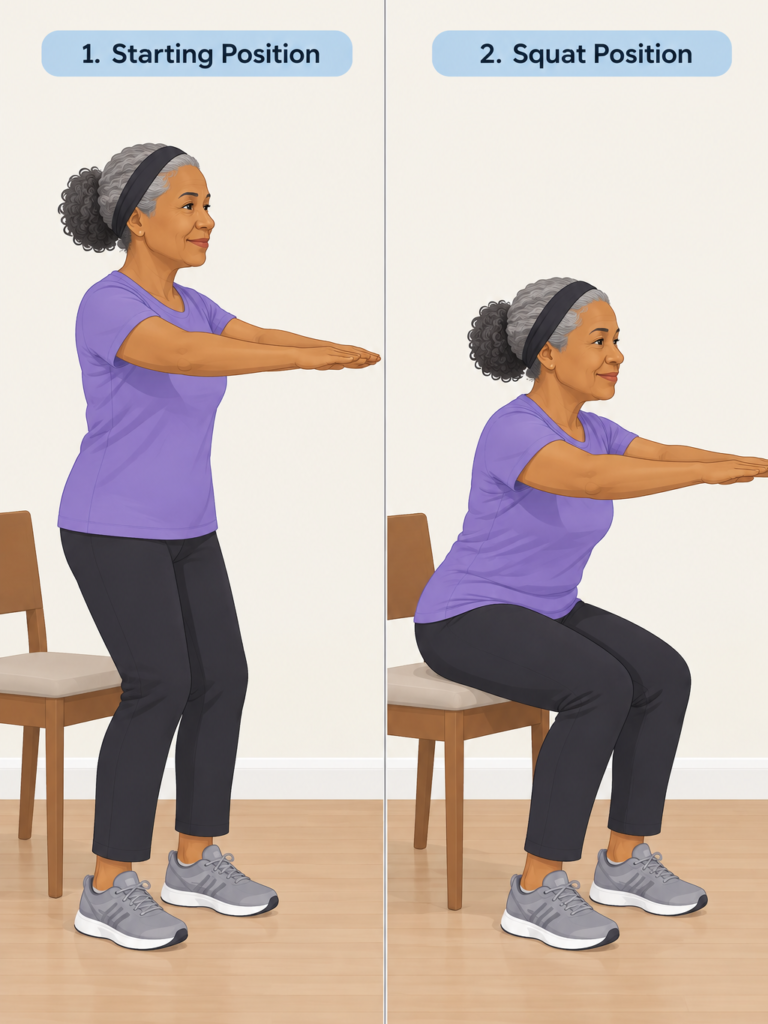
Phase 1: Sit-to-Stand
- Stand directly in front of a sturdy chair placed against a wall for stability, with your feet shoulder-width apart.
- Keeping your chest up and looking straight ahead, inhale and lower yourself into a sitting position. Your arms should be stretched out in front of you or crossed over your chest so you are not tempted to push off your thighs.
- Once you are seated, exhale and drive through your feet to stand back up.
Repeat the movement slowly and under control.
Phase 2: Chair-Assisted Squats
Once you’ve gotten comfortable with phase 1, you can progress to a chair squat, using the chair purely as a depth guide rather than sitting down completely.
- With the same starting posture as the sit-to-stand, inhale and lower yourself as if you are going to sit.
- Lower your body until your glutes (buttocks) barely touch the chair. Do not sit down or release your body weight.
- Then, as soon as you feel the chair, exhale and drive through your feet to return to a standing position.
Remember to keep your knees pointing slightly outward throughout the movement and not collapse inward, as this can place unnecessary stress on the joints.
Once you are comfortable with phase 1 and phase 2, you can progress to a regular squat without a chair, while still maintaining good balance and control.
Hip Hinge
The hip hinge workout is another beginner-friendly exercise that involves bending forward by pushing your hips backward while keeping your spine in a comfortable, neutral position.
When performed with proper technique, it targets the hamstrings (back of the thighs), glutes (buttocks), lower back muscles, and core(abs).
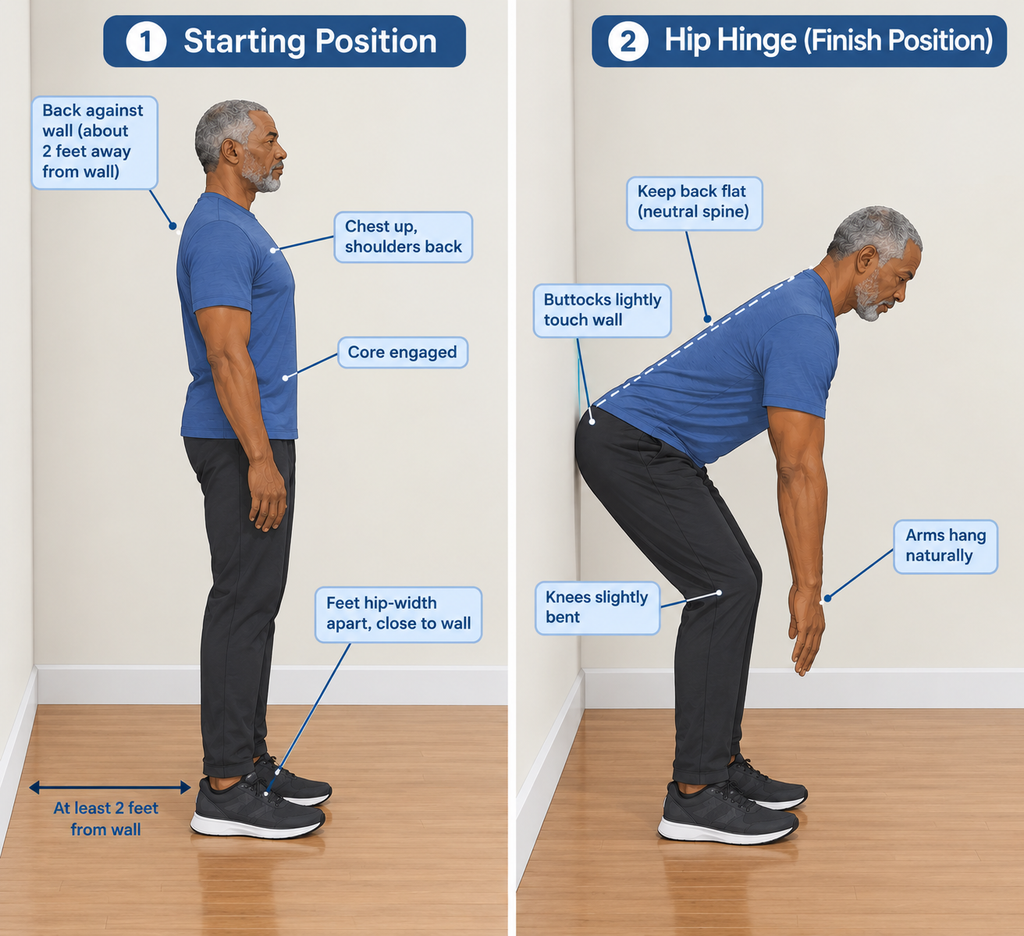
Step-by-step guide on how to perform a hip hinge.
- Stand roughly two steps away from a wall with your back facing it. Your feet should point straight ahead and be positioned hip-width apart. Then bend your knees slightly, but not so much that you are in a squat position.
- Next, to feel the movement, place your hands on your hips, where they meet your torso, and keep your chest lifted and spine neutral. Then Inhale, push your hips backward until your glutes gently touch the wall. This movement will cause your torso to tilt forward in a bend naturally.
- Once you are in a comfortable bending position, exhale, press your feet into the floor, and push your hips forward to return to a standing position. Squeeze your glutes at the top, then repeat.
For adults over 50, mastering the hip hinge can help improve strength, balance and mobility needed for daily tasks involving bending, such as picking something up from the ground, vacuuming, making the bed, or gardening.
Push Exercises
Push exercises involve moving resistance away from your body. They target muscle groups such as your pectorals (chest), deltoids (shoulders), triceps (back of the arms), and core.
For people over 50, a well-designed push workout improves the functional strength needed to push open heavy doors, get up from the floor, or push yourself out of bed. Below is a beginner-friendly exercise you can do without equipment.
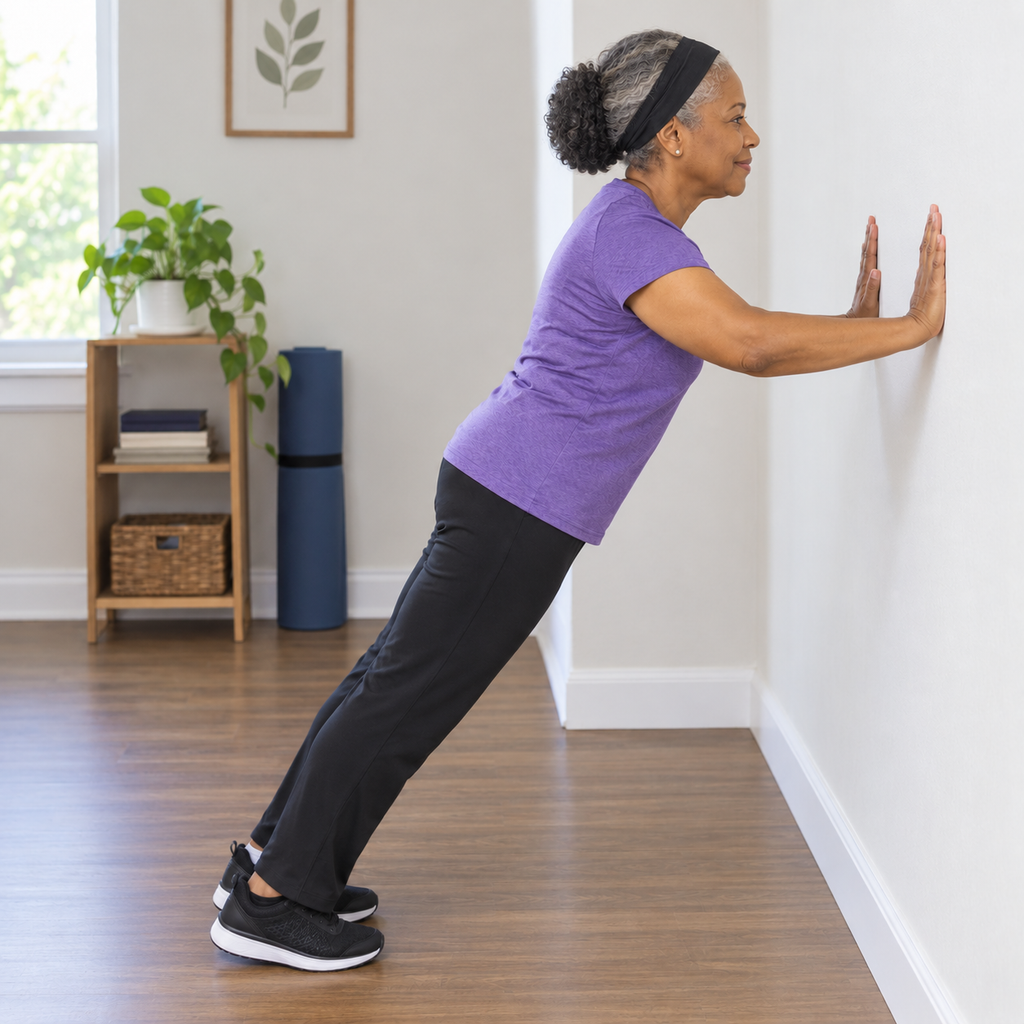
- Facing a sturdy wall, stand about an arm’s length away with your palms laid flat against the wall at shoulder height and at a width slightly wider than your shoulders.
- . Step your feet back so your body is inclined at a slight angle. Keep your body in a straight line, like a plank.
- Bend your elbows to lower your chest slightly towards the wall, then push firmly against the wall to return to the starting position.
Tip: To make it easier, stand closer to the wall. To make it more challenging, step your feet farther back
How often should adults over the age of 50 strength train
You don’t have to spend hours in the gym every day to see progress. A good starting point for older beginners is to do a full-body workout targeting all major muscle groups two non-consecutive days per week. This would ensure you have enough time for rest and recovery, which are also necessary for muscle growth
For example, you could schedule your workouts on Monday and Thursday, giving your muscles time to rest between sessions. Doing too much too soon can strain your muscles, whereas sticking to a routine consistently has been proven to show better results over time.
As your body becomes stronger and you get more comfortable with the exercises, you can gradually increase the duration, resistance, or frequency of your workouts. Remember, consistency matters more than trying to do too much at once.
Common Mistakes Older Beginners Should Avoid
Our tendons, ligaments, and joints usually take longer to adapt to exercise than muscles do, therefore, beginners need to train smart.
Here are certain mistakes beginners should avoid in order to stay consistent and reduce the risk of injuries when doing a strength training exercise.
1. Skipping the Warm-Up
Going straight to weights or resistance bands without preparing your body for exercise could strain tight muscles and can cause workout injuries.
The Fix: Spend 5 to 10 minutes doing light movements like shoulder circles, gentle torso twists, arm swings, and marching in place. A warm-up gradually increases blood flow to your muscles and prepares your body for exercise.
2. Prioritising Weight Over Form
Lifting weights that are too heavy, incorrect posture or form, moving too quickly, or using momentum instead of muscle are all common mistakes that can either lead to injury or slow progress.
The Fix: Start out with weights that are manageable, then build up gradually over time. As a beginner, starting out with comfortable weights will help you focus on slow, controlled movements and maintain proper technique. A good reference will be, if you cannot complete your repetitions smoothly without straining, then you have to drop the weight or reduce the resistance.
3. Holding Your Breath
Holding your breath while working out can cause sudden increases in blood pressure and may lead to dizziness, particularly in people with certain health conditions.
The Fix: Follow the golden rule of breathing: exhale during the hardest part of the movement, such as pushing or lifting, and inhale as you return to the starting position.
4. Ignoring Joint Pain
Following the old “no pain, no gain” mentality. Hurting does not necessarily mean you are getting it right, and pain could be a sign for you to stop and listen to your body.
The Fix: There is a difference between ordinary muscle fatigue and pain in your joints. If an exercise causes sharp pain, it is your sign to either stop the workout immediately, modify the movement, use lighter resistance, or skip it entirely. You also need to seek professional advice if the pain persists.
5. Overtraining and Neglecting Recovery
Training too many days in a row or attempting an hour-long workout right from the start. This can lead to excessive soreness, exhaustion, and burnout.
The Fix: Start out with two strength training days a week, keeping your workouts to around 20 to 30 minutes. You can gradually increase the intensity and training intervals of your workout as you get stronger while bearing in mind that your muscles need time to recover and adapt after exercise.
6. Avoiding Gym Machines
Thinking you must use free weights like dumbbells or barbells because that is what you see in fitness videos.
The Fix: Embrace gym machines! Weight machines can be useful for older beginners because they guide your body through a controlled path of movement and may make certain exercises easier to perform safely.
When Should You Talk to a Healthcare Professional?
You would have to consult with your doctor before starting a strength training routine if you
have a chronic health condition, bone and joint Issues, are taking a new medication, or are having unexplained symptoms such as frequently experiencing dizziness, balance issues, or unexplained chest or joint pain during daily activities.
Getting professional advice can help you develop a routine that suits your health, abilities, and fitness goals better.
The Bottom Line
Ageing is a natural part of life, but losing your strength, mobility, and independence doesn’t have to be something you have to accept, especially when there is a more rewarding alternative.
The benefits of strength training cannot be overemphasised, as it helps to maintain and build muscle mass, support bone health, improve movement, and make everyday activities easier as we get older.
And the best part is, you can get started from the comfort of your home. You don’t need expensive equipment or hours in the gym to get started. All you have to do is pick one or two simple exercises to start with, focus on proper form, and gradually increase the challenge as your body adapts.
Whether you’re 50, 60, or 80, it’s never too late to start building strength. So, why not take that first step today and let your future self thank you!